
What a Denver Resident Lookup Covers
There is no universal Denver resident directory. A sound resident lookup triangulates records that answer different questions and carries the source date with each result. The parcel and deed routes are property evidence. The voter form is a narrow person match. Court, vital, license, business, custody, and registry systems have their own fields and public boundaries.
| Record | What it confirms | Where to search | Access boundary |
|---|---|---|---|
| Assessor parcel | Named owner, situs, mailing address, legal description | Spatialest current parcel data | Address or parcel search; mailing address is not occupancy proof |
| Recorder deed | Party names, transfer or lien event, recorded date, legal description | Denver PublicSearch | Index first; image or certified copy may need a request |
| Voter lookup | Name and registration match or status workflow | Colorado first name, last name, ZIP, birthday form | Confidential and protected records may not appear |
| State docket | Case number, party, type, dates, attorney, event or disposition clue | Colorado Judicial Branch docket | Docket is not the complete file |
| Denver County Court | Limited case or arrest-booking bridge and future date result | Official case portal | Case number or AB# route; date forms are limited |
| Vital event | Eligible birth, death, marriage, civil union, or divorce fact | CDPHE, county clerk, or district court | Confidential; direct and tangible interest, ID, and proof |
| License or business | Credential, organization, status, agent, or filed address clue | Colorado Department of Regulatory Agencies (DORA), Colorado Secretary of State (SOS), or Denver Accela | Affiliation or contact field is not residence proof |
| DOC or CBI | State custody or a qualifying registry result | Official state portals | Limited current or categorical coverage |
Colorado Judicial's public-records access guide makes the key distinction plain: an index or docket can point to a record, while a clerk controls the complete file, certified copy, and any protected material.
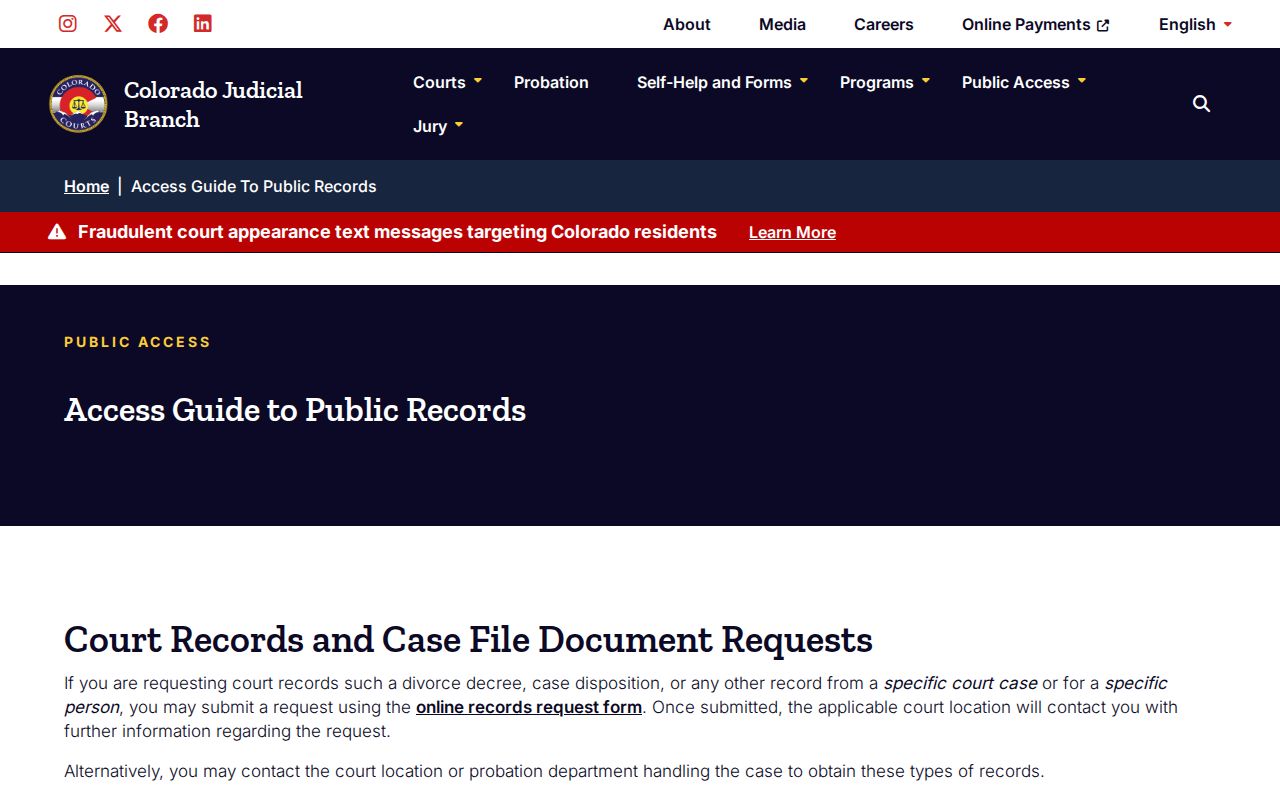
The right first source depends on what is already known. Start with an address for a parcel, a name and date for a court event, or an eligible family relationship for a vital record.
Denver Resident Name and ZIP Checks
The Colorado voter lookup is person-first. It requires first name, last name, ZIP, and birthday. A recently moved voter may need the previous ZIP. A confidential record or voter under 18 may not appear. That result is a registration match or status workflow, not a street-wide list and not a complete address history.
| First name | Required text matching the registration name |
|---|---|
| Last name | Required text matching the registration surname |
| ZIP | Required ZIP code; try a prior ZIP after a recent move |
| Birthday | Required date or text in MM/DD/YYYY form |
| Return | Match or no-match response; exact live result fields were not copied |
Colorado voter materials distinguish public name, residential and mailing address, year of birth, party affiliation, vote history showing participation rather than ballot choice, and active or inactive status from protected full birth date, identification data, and confidential records. A full voter-file request is a separate election-use product with secure-handling and no-distribution terms. It is not a general people list.
Denver Resident Court Records
The Colorado Judicial docket search filters by location, date, case number, party, and attorney. Location can narrow judicial district, county, courthouse, court type, or division. Date uses a range or specified date. Case number uses a four-digit year, case class, and sequence. Party search separates individual and business names. Attorney search uses a name or bar number. At least one filter beyond date is required.
Denver County Court is narrower. Its public portal accepts a case number or arrest booking AB#; its Find Court Date form uses last name, first name, and DOB for active future dates; Civil Court Date uses last name and first name or business for active future civil cases. These forms are not complete historical case-file searches.
Denver County Court services directs official file questions to the proper clerk. The Colorado Judicial request form generally lists 3-5 business days, with a government photo ID required for suppressed, juvenile, or protected information. Its stated fees include $0.25 for an electronic or coin copy, $0.75 for a paper court copy, $5 for a nonparty search including a register of actions, $30 per hour for research or redaction after the first hour, and $20 for a certified or exemplified copy. Those are request-form figures, not a promise that a file is releasable.
| Case identity | Case number, filing year, class or type, court, county, courthouse, and division |
|---|---|
| People | Party names, business name where used, attorney and bar number when public |
| Dates | Filing, docket event, hearing, judgment, or disposition dates when shown |
| Substance | Event line, register-of-actions entry, disposition or sentence clue, and document description |
| Restrictions | Juvenile, sealed, expunged, adoption, protected family, and personal identifiers may be suppressed |
Denver County Court's service route explains where a docket clue becomes a formal file or transcript request.
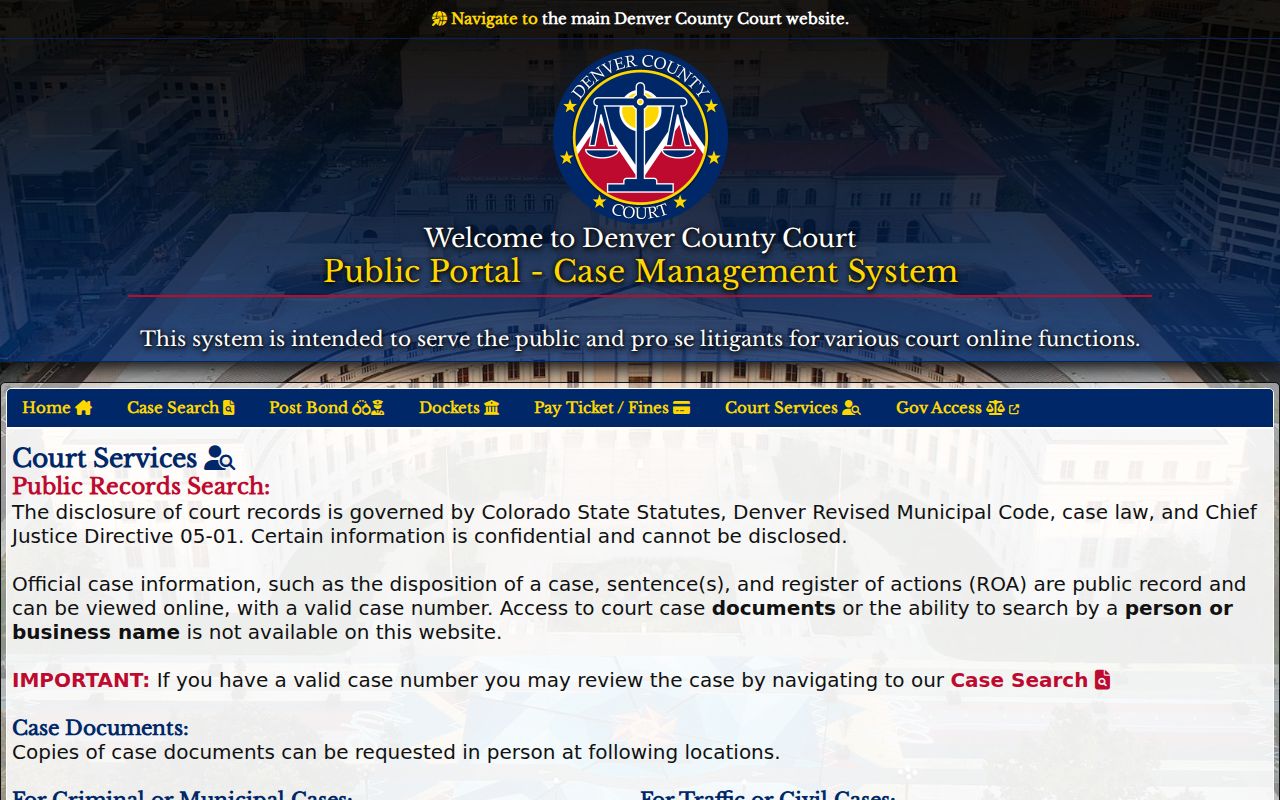
A docket result is a dated clue. It does not prove a final judgment, current address, or access to every exhibit. Request the document when the case number and custodian matter.
Note: A docket calendar status does not establish that every pleading, exhibit, or certified copy is public.
Verifying a Denver Resident
Verification means making two or more records agree on name, place, and time. An exact name alone is not enough. Use a source-specific address label, such as situs, mailing, voter residence, registered agent, or directory address, and keep the label in the note.
- Anchor the name with an address and parcel, or with a name, ZIP, birthday, and dated event.
- Normalize middle initials, suffixes, married or former names, hyphenation, and shortened street forms while preserving the original spelling.
- Run the voter form only when its four fields are lawfully available, then record match or status without copying protected data.
- Compare a dated deed, court event, business filing, license, or directory entry. Check whether the address is a situs, mailing, organization, or historical field.
- Ask the custodian for a certified copy or correction route when the index stops, the image is missing, or the record needs legal weight.
- Docket
- A court's dated list of case events, parties, and status clues. It is not the complete case file.
- Index versus image
- An index points to a record. An image is the scanned instrument or page, and it may be absent or restricted.
- Certified copy
- A custodian-issued copy with certification for a permitted use. It is different from a downloaded index result.
When two records conflict, preserve both citations and test the dates, address type, and spelling before choosing a match. A custodian can explain a field or correction route, but a public result should not be enlarged beyond what it shows.
Denver Vital Records Stay Confidential
Colorado vital statistics are not a public online name index. Under C.R.S. §25-2-117, vital records are confidential and a certified copy may go to an applicant with a direct and tangible interest. The applicant may need ID, relationship proof, or legal proof. CDPHE, a county vital-record office, the Denver Clerk and Recorder for marriage copies, and a district-court clerk for a divorce file each serve different record paths.
Birth, death, marriage, civil union, adoption, parentage, and dissolution records do not all follow the same request route. A court docket can locate a divorce case, but a state verification is not the full case file. A family-history question often starts more safely with a Denver obituary, newspaper, directory, cemetery, or State Archives finding aid, then moves to a vital request only when eligibility is clear.
Note: No fixed public-opening year was located in the current Colorado sources, so confidentiality and direct interest are the reliable access rule.
Denver Resident Business and License Clues
A business or license search can help separate people with the same name, but a filed address is an organization or credential contact unless another source ties it to a residence. The Colorado Secretary of State business system can expose entity name, status, formation or renewal history, registered agent, principal or office address, and officers or managers when the filing type supplies them. Its UCC standard search accepts a debtor organization name or an individual debtor last, first, and middle name. The Include Lapsed option covers the past two years as described on the page.
Colorado SOS Business Functions also routes to trade names, good-standing and fact certificates, certified copies, and filing services. Account or certification functions may involve fees. A filing date and entity ID are stronger keys than a copied name.
DORA's public verification shows License Status, Profession, First or Mid Name, License Type, Last Name, License Number, and a person or facility choice. A partial value can use an asterisk wildcard, and the page tip says less is more. Board history and complaint rules vary, so a license match confirms a credential record, not a current home address.
Colorado's public license verification gives the field set used for a professional or facility check.
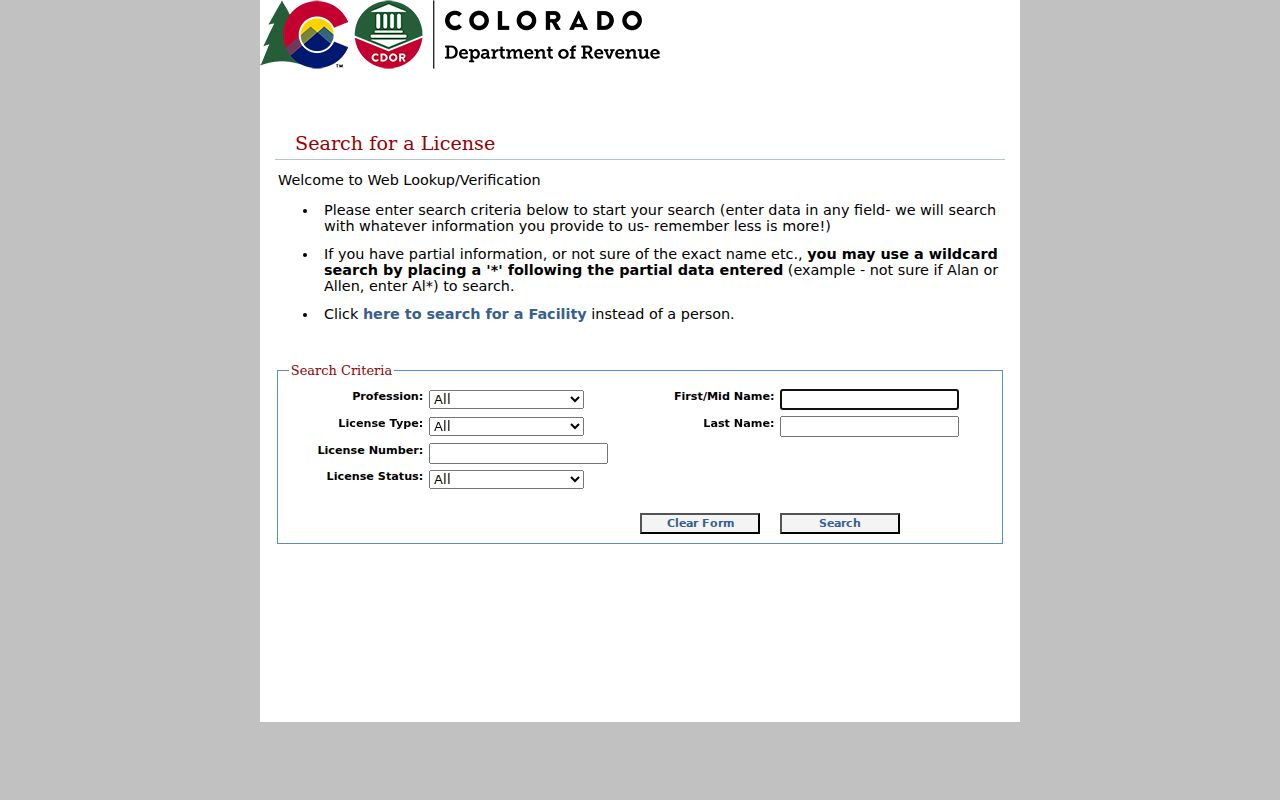
The license result is most useful when its profession, status, number, and source date are compared with a separate parcel, court, or directory clue.
Denver Resident PACER Fees in 2027
Federal court records add a separate route for a Denver resident lookup. The District of Colorado uses Public Access to Court Electronic Records (PACER), which requires an account. The current fee description is $0.10 per page, a $3 document cap, $2.40 for audio, no cap for search-result pages, and an automatic waiver when charges total $30 or less in a three-month period.
A June 26, 2026 notice says a temporary fee increase is scheduled for January 1, 2027: $0.12 per page and a $40 waiver threshold. Check the live District of Colorado PACER route when a federal case is part of the question. The date matters because a current fee screen can change while a research note remains old.
When a Denver Resident Lookup Fails
A blank result is often a boundary, not a negative finding. A voter may use a confidential address program or fall into a protected category. A court record may be sealed, juvenile, expunged, or outside a limited portal. A vital event may require direct and tangible interest. An OCR index can miss a scan, and a deed can have an image gap.
Colorado's custody locator uses a DOC number (DOCNO), last name, first name, gender choices of all, male, or female, and a CAPTCHA. It does not show a verified historical cutoff, so absence is not a complete custody history. The CBI public registry covers limited categories, including sexually violent predators, multiple offenders, people who failed to register, and adults with a qualifying felony conviction. It excludes misdemeanor-only cases and juvenile adjudications, so it is not a general criminal-history search.
Great Colorado Payback can return a possible owner-name match for unclaimed property, but a claim is free only after identity and ownership proof. It is not a current-address directory.
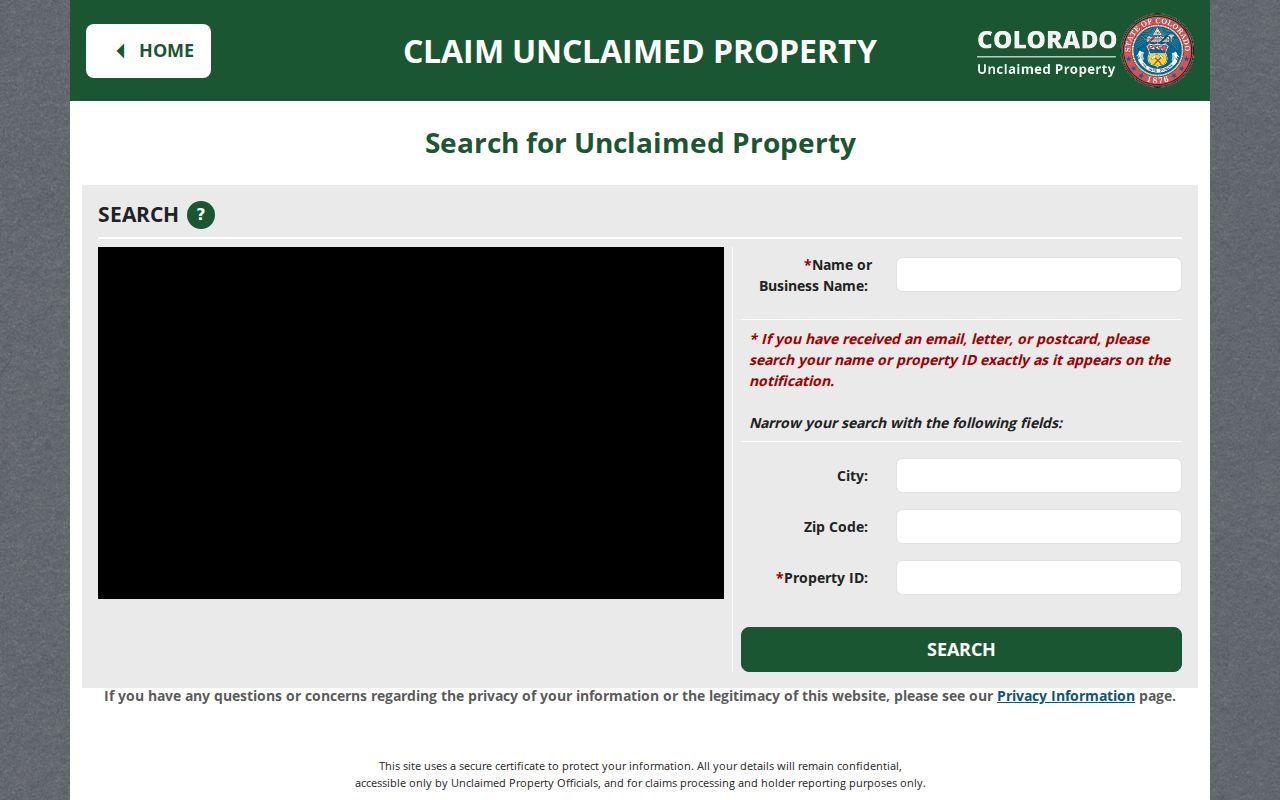
The result tells a searcher where to shift next: request the reception number, ask the court clerk for the file, use DPL's historical directory route, or return to the exact custodian instead of filling a gap with an assumption.
The Colorado CBI registry publishes only its qualifying categories and states that it does not list every convicted offender.
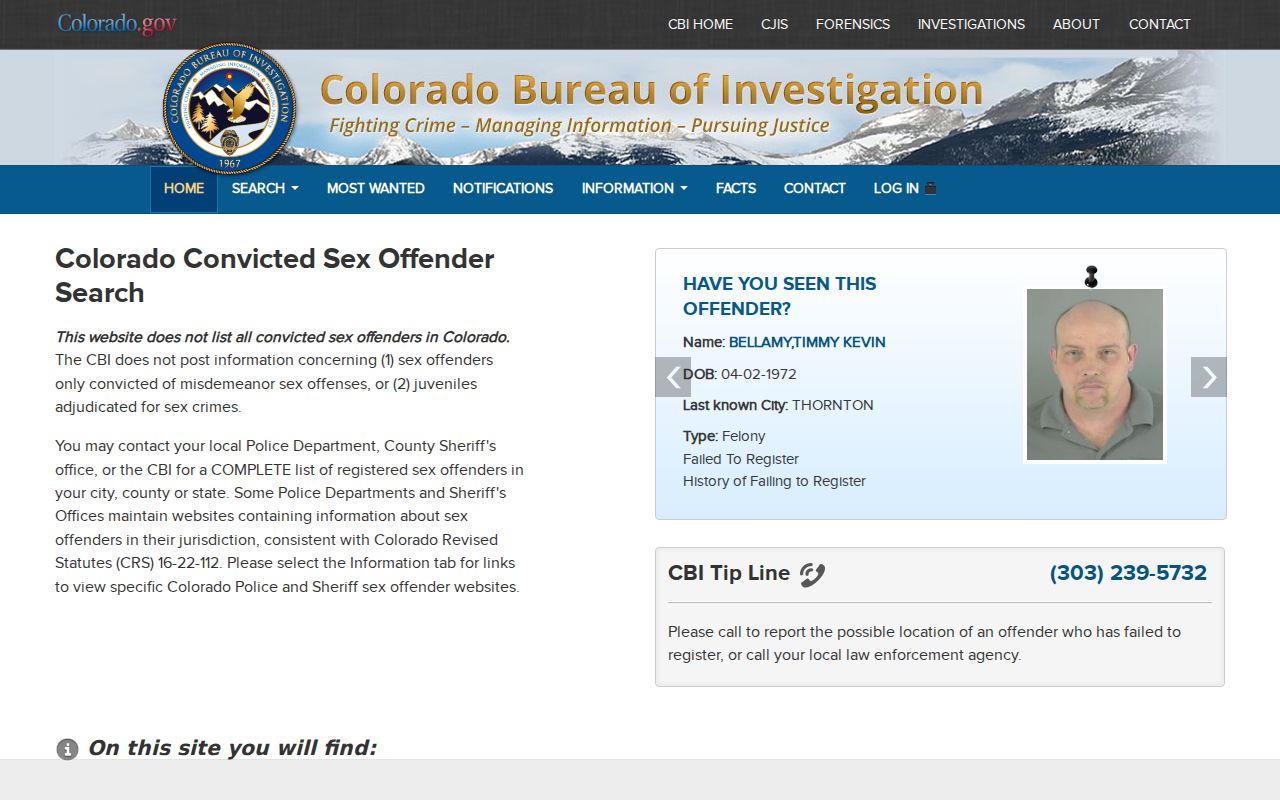
A registry result must be read with its category and reported date. It should not be stretched into a claim about a person outside that official scope.
Note: A limited registry result cannot stand in for a complete criminal-history record or a broader conclusion about a person.
Legal Limits on Denver Resident Lookups
Colorado Open Records Act access applies to public records held by a custodian, but it does not open vital certificates, sealed court files, protected voter data, or other records closed by law. A correction belongs with the office that created the record: the Assessor for a parcel field, Elections for registration status, the court clerk for a docket, SOS for a filing, DORA for a license, or a library for a scan.
The Colorado Address Confidentiality Program can provide a legal substitute address and confidential mail forwarding for qualifying survivors of domestic violence, sexual offenses, or stalking. Election rules can keep an actual address, county, precinct, and split confidential while a substitute address is used. Do not publish an exact protected address, birthday, phone number, ID number, or unnecessary family detail.
Lawful use. A Denver resident lookup is for personal, lawful research. Do not use a record to stalk, harass, intimidate, or harm another person, and do not treat a blank result as permission to seek protected details.
Keep the original citation, source date, and uncertainty note. A careful lookup verifies the right person without turning a limited public record into a private dossier.