
Denver Previous Residents: Era by Era
A house history works best when each record set is given its own date range and purpose. The land index can reach far earlier than a digitized image. A city directory may show a name every year but not prove title. A criss-cross volume starts with an address, while the census appears only at released intervals. The following coverage map keeps those trails distinct.
| Source | Years It Covers | Where Held | What It Shows |
|---|---|---|---|
| Recorded land database | 1859-present stated by audit; DPL guide highlights 1859-1986 | PublicSearch, Clerk, DPL, Archives | Parties, dates, reception, book/page, legal description, image when digitized |
| Digitized grantor/grantee books | Selected 1859-1884 books | DPL digital collection | Ledger entries and deed-book references |
| Assessor ledgers and cards | 1870s-1917 ledgers; cards late 1950s-early 1980s | DPL and State Archives | Parcel, block/lot, ownership, and tax clues |
| Denver city directories | 1866-1981 microfilm; 1873-1923 digital; Ancestry to 1979 | Denver Public Library Special Collections and Archives (SCA), digital collections, Ancestry | Name, address, occupation, household notation |
| Householder/criss-cross | 1924-2018 holdings; 1924-1937 digital | DPL SCA and digital collection | Address-first occupants or businesses |
| Building logs and permits | 1889-1892, 1900-1914 logs; 1915-1955 permits; 1955-1959 gap; later routes | Library, city permit offices, online permit portal | Construction, changes, projects, and applicants |
| Sanborn maps and atlases | 1887; 1890-93; 1903-04; 1929-30; pasteovers | LOC, DPL, ProQuest, SCA | Footprint, use, materials, lot context, street names |
| Federal census | 72-year release rule; schedules through 1950 under current practice | Federal archives and library databases | Household composition and address or ward context |
| Newspapers, obituaries, probate | Runs vary by year | DPL, court, and state history collections | Deaths, heirs, moves, sales, and civic clues |
Start with the source closest to the question. Use the current parcel and deed index for title, directories for occupants, maps and permits for the building, and newspapers or probate for the end of a household trail. A gap in one row does not end the research.
A 1859-Present Denver Deed Trail
Denver's records history has a useful tension. The Auditor's records-management audit describes a CountyFusion database with more than 11 million documents and database coverage from 1859 to the present. Newly imaged documents were uploaded overnight for next-day availability, yet paper material still sits in city and offsite storage. An index can therefore be broad while the image, book, or older paper instrument remains outside the online view.
The practical handoff is equally important. The Denver Public Library building-history guide describes a 1859-1986 grantor/grantee index for older research, while selected DPL scans cover books from 1859 through 1884. Use the current PublicSearch route for a recent reception entry, then move to DPL or the Colorado State Archives finding aids when the date is early, the result is paper-only, or the image is missing.
The Denver records-management audit gives the clearest picture of the long database horizon and the paper-image gap.
The audit is a reason to keep a request path in every house-history note: “indexed” and “digitized” are separate status fields.
Trace Denver Previous Residents Through Title
Begin with the current parcel in Spatialest. Save the schedule number or PARID, situs address, owner label, owner mailing address, tax year, and legal description. Then use the current owner as grantee in the Denver Clerk and Recorder's PublicSearch index. The seller on that deed becomes the next earlier grantee. Repeat until the legal description changes or the web index stops.
- Pull the current parcel and keep situs, mailing address, ZIPBASE, and legal description in separate fields.
- Search the current owner as grantee, add a broad recorded-date range, and open the latest matching reception number.
- Record grantor, grantee, recorded date, document type, book/page or reception number, legal description, and image status.
- Search the prior seller as grantee. Compare the legal description and plat before treating the result as the same parcel.
- When the online route ends, request the reception number or move to DPL ledgers, State Archives, microfilm, or a counter terminal.
The Denver recorded-document search instructions describe the guest search and reception-number path.
The search result is an index pointer until the instrument or a custodian's copy confirms the underlying event.
- Grantor and grantee
- The grantor transfers or releases an interest; the grantee receives it. Search direction matters when walking backward.
- Chain of title
- A dated sequence of recorded transfers tied to one parcel or legal description.
- Legal description
- The lot, block, subdivision, or metes-and-bounds wording that can remain stable when a street number changes.
Missing Images in Denver Deed Records
A missing image is a routing problem, not proof that the transfer did not happen. Denver's recording instructions say to email the Recording Division with the reception number when an online image is unavailable. Counter assistance, a public terminal, DPL's historical grantor/grantee volumes, State Archives finding aids, and microfilm are additional channels. A precise request should name the parcel, legal description, approximate date, party names, and document or reception number.
Older records may be indexed under a subdivision, addition, block, lot, or grantor/grantee reference rather than today's street string. DPL's assessor guide describes a ledger method that moves from addition or subdivision to block and lot, then follows the deed-book reference. Keep a note of every unsuccessful spelling and address variant so the next search is narrower.
For a missing image, the recorded contact route is recording@denvergov.org with the reception number. Phone help listed in the research includes the Assessor at 720-913-4162, the Clerk at 311 or 720-913-1311, and DPL Special Collections and Archives at 720-865-1821.
The DPL Denver grantor and grantee collection shows the historical ledger route for selected early volumes.
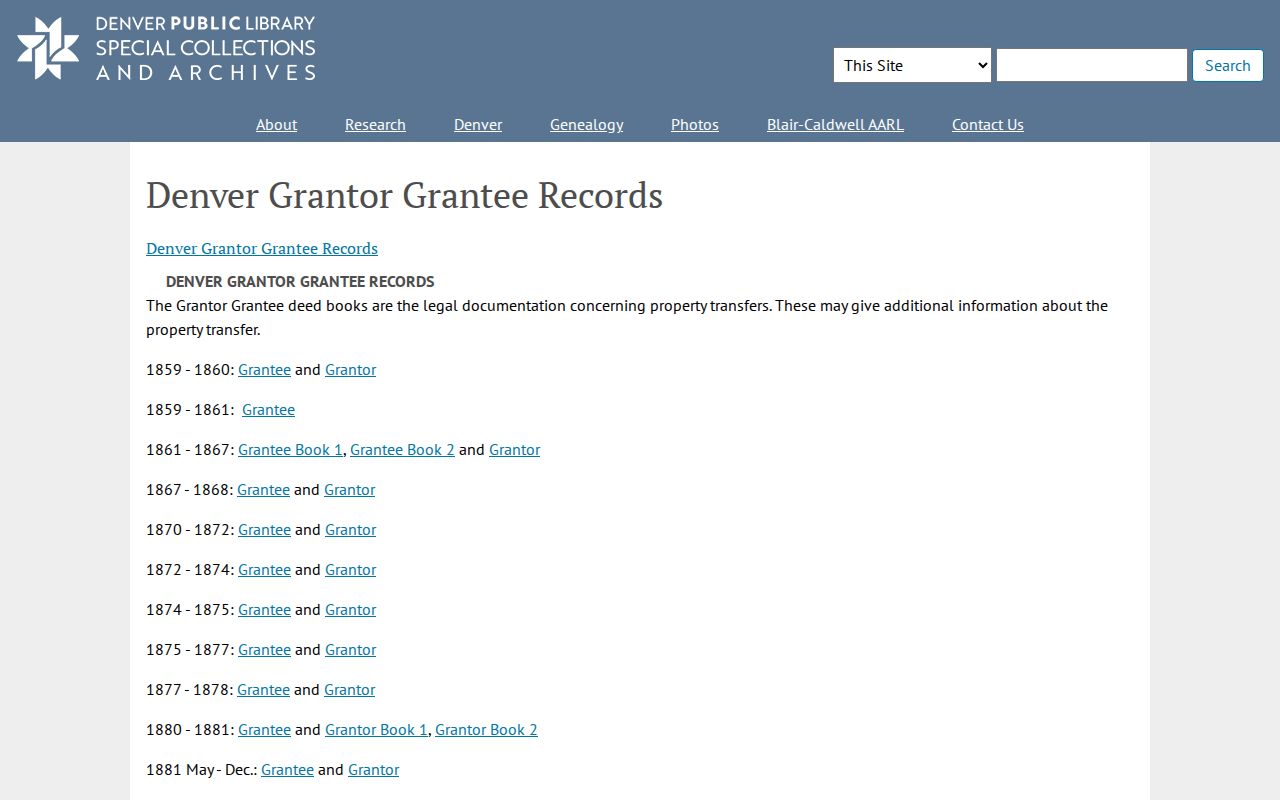
Ledger entries are a bridge to a deed book, not a complete modern parcel card. Preserve the page or volume citation before moving to the next source.
Denver Previous Resident House History
Denver Public Library's Special Collections and Archives combines the tools that make previous-resident research workable: directories, subject-index cards, newspapers, maps, permits, photographs, and licensed databases. The building-history research sheet organizes the work into ownership, occupants, maps, and newspapers. It is a better structure than copying a string of names because it keeps each claim tied to a source and date.
Historical assessor material adds a separate layer. DPL's guide points to the earliest assessor ledgers from the 1870s through 1917, handwritten material from the late nineteenth century through the early 1950s, and master cards from the late 1950s into the early 1980s. The records can reveal block, lot, prior owner references, and tax clues, but they do not automatically identify who occupied a house.
The DPL assessor-records guide explains how historical parcel research connects ledgers, cards, additions, and deed references.
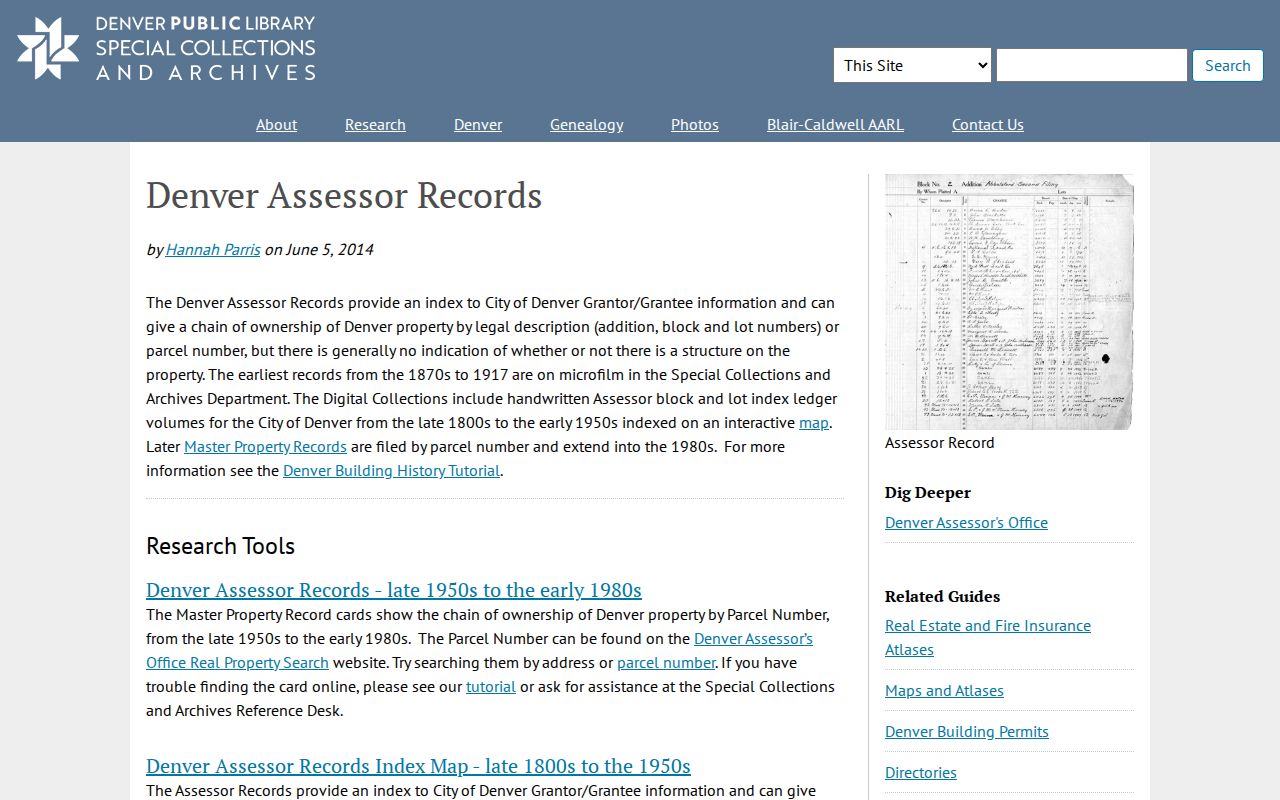
For a library request, include the address variant, estimated year, surname spellings, and the edition or ledger range already checked. The SCA contact route listed in the research is 720-865-1821.
The DPL house-history research sheet is useful for keeping ownership and occupancy evidence in parallel columns.
Denver Previous Resident Address Changes
A directory search can fail because the house number or street name changed, not because the household left. Denver DOTI material says a street rename affects legal documents, maps, and 911 references. Address assignment is handled by the City Engineer under DRMC 49-56 and a 2010 policy. Search the old and new strings, then bridge them with the plat, block and lot, parcel number, map landmark, permit, and legal description.
The Denver DOTI address policy is the local reference for municipal assignment and address continuity. It is separate from USPS delivery geography.
When the legal description changes, stop and inspect the subdivision or plat. A lot split, consolidation, or metes-and-bounds description may create a new parcel relationship. Mark the transition rather than joining two address strings by guesswork.
Denver Past Households Across Directories
The household layer is where previous residents become more than names on deeds. Denver city directories run from 1866 to 1981 on microfilm, with 1873-1923 digital material and Ancestry coverage from 1866 and 1871 through 1979. Householder and criss-cross directories run from 1924 to 2018 in holdings, with 1924-1937 digitized. The city directory is usually person-first; the criss-cross volume is address-first.
- Capture a name, address, occupation notation, spouse or household mark, page, and edition title from the alphabetical directory.
- Check the same year in the householder or criss-cross volume for the address, other occupants, business notation, or a number variant.
- Move one edition at a time and read the front matter for street changes, ward information, and abbreviation keys.
- Pair the directory line with a census year, deed date, newspaper, permit, or obituary. A missing edition does not prove a move.
Federal census schedules follow a 72-year release rule, so directories and deeds can bridge years that are not yet available. Keep a source label such as “directory occupant” distinct from “owner of record.” The collections themselves belong with the Denver city directory research, while the backward address trail stays tied to the parcel.
Denver Previous Resident Sanborn Clues
Maps and permits provide a building timeline that a deed cannot. Denver's Sanborn and atlas material includes 1887, 1890-93, 1903-04, and 1929-30 runs, with pasteovers into later years and incomplete later coverage. Record the sheet, year, footprint, use label, materials, street names, and nearby landmark. A changed footprint can help tie an old legal description to a modern parcel.
Building logs and permits cover 1889-1892, 1900-1914, and 1915-1955, with an identified 1955-1959 gap. Records from 1960-1969 follow city permit and Colorado Open Records Act (CORA) or appointment routes; 1970-present material is a counter route, and 2000-present permit and licensing access is online. The online portal's creation date is not necessarily the issue or completion date.
That gap belongs in the result note. Do not turn an absent 1957 permit into a claim that no work occurred. Use directories, maps, newspapers, and assessor cards to test the same period.
Denver Obituaries and Probate for Past Residents
Obituaries and probate often close a household trail. DPL identifies Denver Post coverage from 1894-1989, Rocky Mountain News coverage from 1860-1925 and 1990-2009, and HeritageHub obituary resources. Search by name, former address, spouse, funeral home, and spelling variant, then save the newspaper title, date, page, and citation. An obituary is a historical clue, not a certified vital record.
If an obituary points to an estate, search the Colorado Judicial docket for a probate case and request the public file from the court. Deeds, assessor cards, and a recorded personal-representative document can show a later transfer. Sealed or protected filings may be absent. Colorado vital records remain confidential under C.R.S. 25-2-117 and require a direct and tangible interest, identification, and relationship or legal-interest evidence.
Lawful house history. Previous-resident research is appropriate for family history, preservation, genealogy, and personal curiosity. Do not use a name, address, or record trail to stalk, harass, intimidate, or expose a living person.
A careful conclusion says what the source proves: a recorded transfer, a directory appearance, a map footprint, or a probate filing. It does not collapse those separate facts into certainty about residence.