
Denver City Directory Collections
Denver Public Library separates alphabetical volumes from householder, street, criss-cross, business, and telephone material. The runs below are real collection descriptions, not a claim that every year is digitized or searchable in one place. Record the product label with the year, because a microfilm reel, a library database, a scanned object, and a hardcover volume can have different search limits.
| Collection | Years and publisher | Where held | Access |
|---|---|---|---|
| Denver city directories | Special Collections and Archives (SCA) microfilm 1866-1981; digitized 1873-1923; Ancestry 1866 and 1871-1979 | Denver Public Library SCA, DPL digital, Ancestry Library Edition | Library, microfilm, or licensed digital route |
| Ballenger and Corbett examples | Digitized examples from 1886, 1887, 1892, 1893, 1894, 1896, 1899, 1900, 1905, 1907, 1911, 1915, 1920 | DPL digital collection | Inspect the dated object and page image |
| Householder, street, criss-cross | 1924-2018 holdings; 1924-1937 digitized | DPL SCA and digital material | Address-first research; exact year varies |
| Polk directories | 1899, 1913, and 1960-1996 hardcover examples | DPL SCA | Ask for the edition and year held |
| Colorado business directories | 1875-1943, 1950, and 1956 | DPL SCA | Business and proprietor context |
| Denver telephone directories | Library of Congress run, 1912-1947 | LOC and DPL holdings | Search by name or address where scans permit |
Denver Public Library's directory collection page is the best starting shelf map. It separates alphabetical, householder, business, and telephone books, while the Colorado Directories Index helps identify titles and years. A listed run is not the same as complete page coverage.
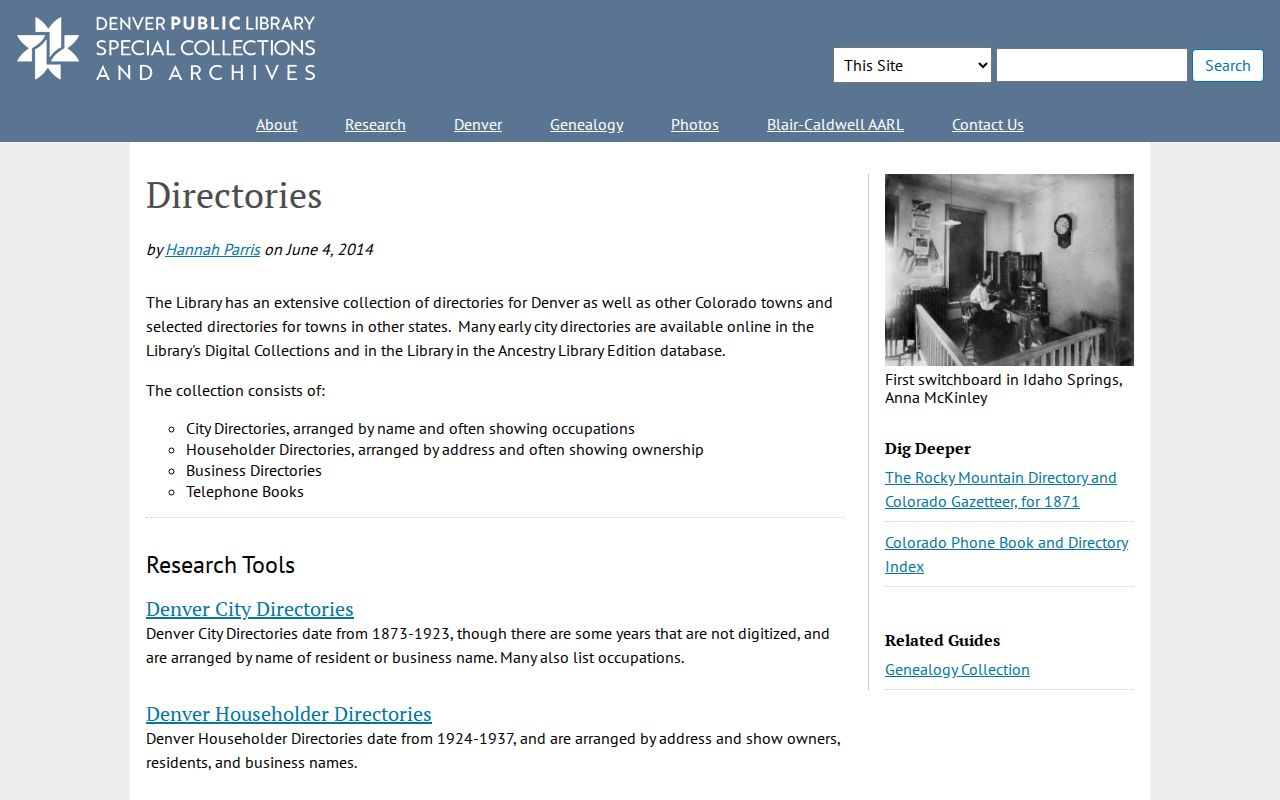
The collection view helps choose the right search direction: person-first for an alphabetical volume, address-first for a criss-cross volume, and business-first for a proprietor clue.
Denver Directory Years and Publishers
The city's directory shelf changes shape over time. SCA microfilm starts in 1866 and runs to 1981, while the digitized city-directory run reaches 1873-1923. Ancestry Library Edition lists 1866 and 1871-1979. Hardcover Polk examples include 1899, 1913, and 1960-1996. Those labels should stay in a research note because two databases may present different spans for what sounds like the same run.
The digitized-object search gives useful named examples: Ballenger and Richards editions in 1892, 1893, 1894, 1896, 1899, 1900, 1905, 1907, 1911, 1915, and 1920, plus 1886 and 1887 directories. It also surfaces 1930 and 1931 Householders' Directory and Street/Avenue Guide volumes. These are actual objects found in the collection search, not a promise that every intervening page or year is online.
Publisher changes can affect abbreviation keys, entry style, page order, and the way a spouse, widow, address, or business is printed. Capture the title page and front matter before comparing a name across years. A typed name match without an edition and page is a weak citation.
Note: A collection run identifies located editions, while the page image and source label determine what can be cited.
Denver Digital Directory Access
Digitized volumes are strongest when treated as page images with search aids, not as a complete name index. Optical character recognition (OCR) can miss initials, faded type, abbreviations, and street numbers. Use the page image, page number, edition title, and object date. If a search returns no hit, try a spelling variant, a surname alone, an address, a spouse, or the front City Record section.
Denver's building-history tutorial points from the directory shelf to related maps, permits, assessor material, and other local sources.
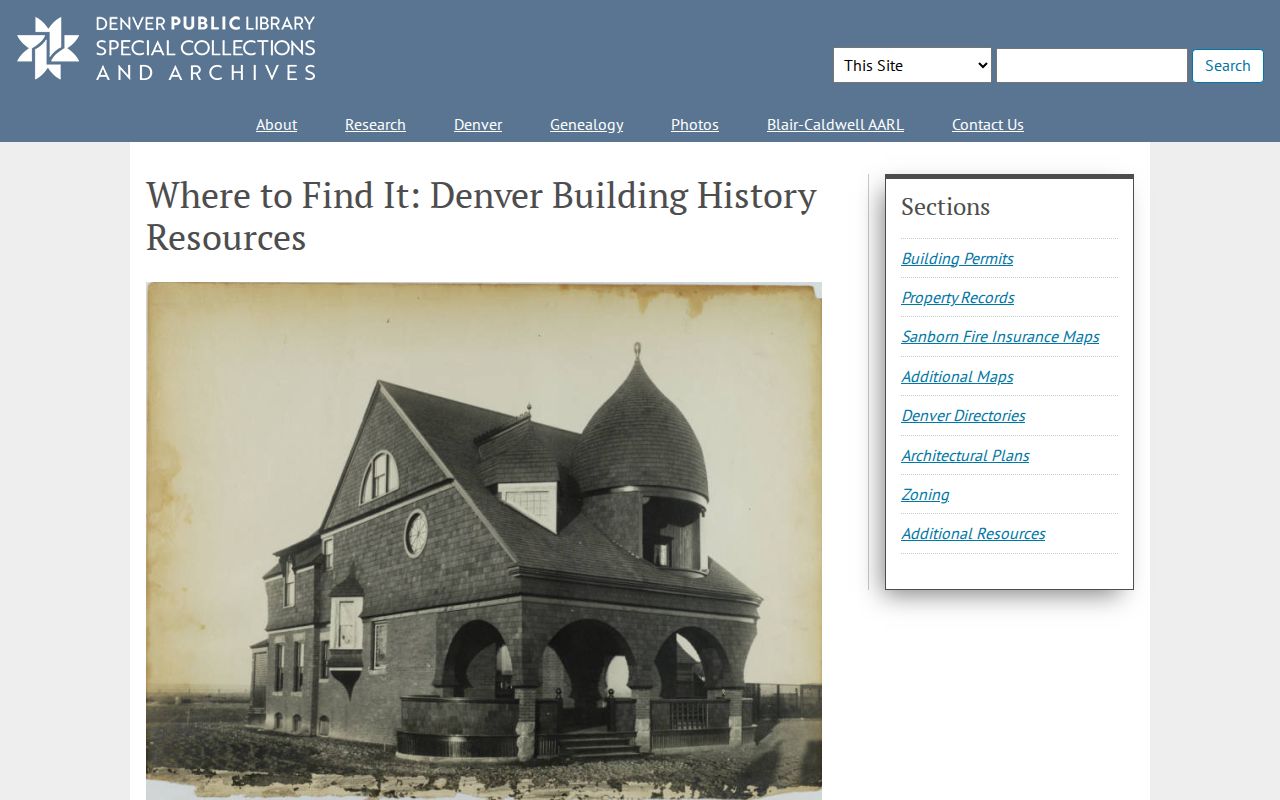
The tutorial's collection map is useful for knowing where to stop trusting a digital search. A microfilm-only year may need a library visit, and a licensed database may show a different run from the open digital collection.
Reading a Denver City Directory
A Denver directory entry is a compact record with a local code. Read the surname, given name or initials, spouse or household notation, address, occupation, and any cross-reference in the order printed. An abbreviation key often sits near the front. A mark for owner or renter, or a widow notation, belongs in the note only when that edition actually prints it. Never expand an abbreviation from memory.
| Name | Surname, given name, initials, and printed spelling or abbreviation |
|---|---|
| Household | Spouse, family, partner, co-occupant, widow, or death notation when printed |
| Address | Street number, street name, directional, avenue abbreviation, and ward context |
| Occupation | Printed occupation plus the edition's abbreviation key |
| Cross-reference | See line, firm, spouse, forwarding note, or prior address when present |
| Front matter | City Record pages with officials, wards, schools, churches, public buildings, and street changes |
- Criss-cross directory
- An address-order volume that begins with a street and number, then lists an occupant or business.
- Householder index
- An address-first directory that can identify a household or business at a place in a given year.
- Abbreviation key
- The volume's own guide to short occupation or status marks. Photograph or cite it before interpreting an entry.
Read the entry as the publisher printed it. A spouse notation, an occupation, a status mark, or a forwarding note can help distinguish two people with the same name, but each clue still needs its edition, page, and date.
Denver City Directory Front Matter
The first pages can solve a search problem before the alphabetic entries do. Denver's City Record pages may list officials, council, wards, schools, churches, public buildings, street changes, and local statistics. A ward or street label can explain why a household seems to disappear when the address system has changed. Advertisements and business listings can also place a firm or service near a family address.
Denver Central Library is at 10 W. 14th Ave. Pkwy., Denver, Colorado 80204. The listing gives 720-865-1111, public hours generally Monday through Thursday 10 to 6, Friday 10 to 5, Saturday and Sunday 11 to 5, and Special Collections and Archives at 720-865-1821 on the fifth floor. Call numbers and hours can change, so confirm before a visit.
The physical room matters when a year is on microfilm, a page is faint, or the catalog points to a box, card, map, or licensed database instead of an open scan.
Note: A front-matter street-change note can be as important as the name entry when a number or ward label shifts.
Denver City Directory Address Search
The householder and criss-cross sequence is the address-first companion to the alphabetical directory. Denver's holdings reach 1924-2018, and 1924-1937 is digitized. Use a street number, then compare the printed occupant or business with the same year's alphabetical volume. The two sources may show different spellings, a spouse, a boarder, an office, or a changed number. None alone proves a present-day connection.
For a street question, save the exact edition, street string, page, and any “see” reference. For a household question, follow the name in the alphabetical volume, then check the criss-cross line for the address. A legal description or parcel key from a current record can help bridge a renamed or renumbered street, but the historical volume remains a dated clue.
Denver City Directory Newspapers
Newspapers help explain a gap between two directory entries. Denver Post coverage in the library resources runs from 1894-1989. Rocky Mountain News material covers 1860-1925 and 1990-2009. HeritageHub adds obituary research. Search a name with a street, spouse, funeral home, business, or variant spelling, then save the paper, date, page, and image rather than a bare search snippet.
Western History adds a second route when the name index fails. Denver Public Library describes more than 250,000 books, 1.1 million digital items, and a subject index of about 650,000 cards and citations spanning the 1850s-1990s. A building, organization, school, or neighborhood card can lead to a resident through a different entry point.
Note: A newspaper or obituary citation can bridge a directory gap, but it remains a separate historical source.
Denver City Directory Maps
Maps and permits anchor an address in its built setting. Denver Public Library building-history collections include permits from 1889-1955, Sanborn and real-estate atlases from 1887 into the 1960s, clippings, plans, photographs, and a subject index. The usable permit pattern is 1889-1892 and 1900-1914 log books, 1915-1955 permit material, no official permits located for 1955-1959, 1960-1969 CPD records through Colorado Open Records Act (CORA) or appointment, 1970-present counter records, and 2000-present online permit and licensing access.
Denver building and neighborhood history collections pair well with a directory because a map can show the lot, footprint, use label, and nearby landmark that a typed address does not explain.
Sanborn and atlas examples include 1887, 1890-1893, 1903-1904, and 1929-1930, with pasteovers through 1951 or 1961 and later incomplete holdings. Save the sheet and year. A map is a bridge across a number change, not a substitute for the directory page.
Tracing Denver City Directory Households
A reliable household trail grows one edition at a time. Start with the exact name, title, year, page, address, occupation, spouse or household notation, and any “removed to” or “see” line. Then search that address in the same year's householder or criss-cross volume. Work forward and back by edition rather than leaping from one distant year to another.
- Normalize initials, shortened street names, married or former names, and directory abbreviations without erasing the original spelling.
- Compare the next edition's address and household notation. A new number may reflect a move, renumbering, or a different printed convention.
- Pair directory years with federal census years, recorded deeds, assessor cards, permits, newspapers, or obituaries.
- Use a missing entry as a prompt to test the next address, telephone book, front matter, or page image quality.
- Close the trail with a citation that names the edition, publisher, year, page, and source location.
A name at an address may represent a family member, boarder, office occupant, or business contact. A directory head-of-household line, a spouse notation, and a parcel owner are different evidence categories. The historical trail becomes stronger when two independent records overlap in both place and time.
Denver Directory History and Context
Denver's local record story also shows why older pages need context. A 2022 Mapping Prejudice Denver StoryMap reports review of about 144,000 land records from 1931-1935 and more than 300 deeds with explicit racist restrictions. That finding is historical context and a lesson in deed reading. It must not be used to label a current owner or resident.
The same caution applies to every printed directory. A printed line captures a source's categories and the date of publication. It can reveal naming patterns, an address, an occupation abbreviation, a ward, or a household clue, but it cannot certify a current identity. Keep the source label and page image with every conclusion.
History Colorado's Hart Research Center provides a separate historical route for Denver deeds, maps, marriages, military records, and organizational collections.
A finding aid, collection title, date range, and requested name or address give an archivist a usable starting point when a directory entry leads into a broader record group.
Historical scale. Denver directory material spans 1866-1981 in the main microfilm run, while householder and criss-cross holdings extend from 1924 to 2018. Those spans describe collection coverage, not uninterrupted digitized pages.