
Start With Denver's Right Record
A Denver residents directory search works best when the first clue determines the first custodian. An address points to the City and County of Denver property viewer. A parcel result can supply a schedule number, legal description, owner name, mailing address, and map position. A known person can be tested in the Colorado voter lookup, a court docket, or a state license record. A family-history question may begin with a city directory, obituary, or newspaper instead. The records answer different questions, so a name match, an owner match, and an occupant entry should never be treated as the same fact.
The official trail is strongest when two dated sources agree. It is weaker when a search depends on a common name, an entity owner, a mailing address, or a directory gap. A blank result can reflect a protected voter record, a sealed court file, an OCR miss, an absent deed image, or a year that the library does not hold. The custodian can explain the gap and certify what the public index cannot.
- Start with the clue in hand: name, address, parcel, court event, or historical year.
- Use Spatialest for a known address or parcel number, and save the legal description separately from the mailing address.
- Use the Colorado voter lookup only with its required name, ZIP, and birthday fields, remembering that protected records may not appear.
- Move from a parcel or party name to the Denver PublicSearch deed index when ownership history matters.
- Use Denver Public Library directories, newspapers, and maps for an older household, then request a missing record from its custodian.
Denver's Resident Records Offices
The consolidated City and County of Denver puts several key record functions under one local government, but the records still sit in distinct systems. The Clerk and Recorder routes recorded documents, marriage records, elections, and PublicSearch. The Assessor ties a parcel to an owner, tax fields, a legal description, and a map. Elections controls the voter lookup and its protected-record rules. Colorado courts, CDPHE, Denver Public Library, and State Archives fill the gaps that a current local parcel search cannot.
Denver Clerk and Recorder
200 W. 14th Ave.
Denver, CO 80204
311 or 720-913-1311
Denver Assessor
City and County of Denver
Public property information
720-913-4162
Colorado Elections
1700 Broadway, Suite 550
Denver, CO 80290
303-894-2200
The Clerk and Recorder's published contact route lists weekday counter hours of 8:00 a.m. to 5:00 p.m., with 311 inside Denver and 720-913-1311 outside the city. Online certified copies are listed as $1 per document plus $0.25 per page, but current fee notices should be checked before payment. If an indexed reception number has no image, the Recording Division directs a request to recording@denvergov.org.
The office map is practical, not just administrative. A property question can move from Assessor to Recorder. A name question may move from Elections to court or state records. A historical address usually moves to Denver Public Library Special Collections and Archives, where staff can identify the right reel, book, or digital object.
The Denver Clerk and Recorder routing page shows how the city joins recorded documents, marriages, elections, courts, and library resources without making them one searchable resident list.
The Denver Property Record Search is the better first screen when an address or parcel is known. Its result is evidence about a parcel and its owner fields, not a direct statement about every person in the household.
Denver Resident Parcel Search
Spatialest is unusually clear about what it can and cannot do. The inspected Denver interface accepts an address or a Parcel Number, also called a schedule number or PARID in the result. It does not show a direct owner-name search box or a direct ZIP filter. That means a person-first search often needs a second step: find an address, open the parcel, then read the owner and mailing fields. The map supports full and shape searches, so a visual parcel check can help when a street string is old or incomplete.
| Control | What it does | Research note |
|---|---|---|
| Address | Text or autocomplete query | Use the situs street address and house number. |
| Parcel Number | Text or autocomplete query | Use the schedule/PARID when a legal parcel key is known. |
| Map and shape | Visual parcel selection | Useful for adjacent parcels and a street segment. |
| Sort | Schedule number, address, or owner name | Sorting is not the same as an owner-name search. |
| Export | Excel result export | The inspected interface caps the result view at 300 and export at 500. |
Parcel details can show full or situs address, owner names, OwnerFullAddress and ZIPBASE, legal description, class, land-use code, zoning, tax district, land and building square feet, values by tax year, tax notices, sale date, and sale price. The label matters. Situs means where the parcel sits. OwnerFullAddress is where notices go. A mailing ZIP outside Denver does not prove that the owner lives elsewhere, just as an owner name does not prove occupancy.
For a wider view, the map layers include OpenStreetMap and Nearmap Aerial basemaps, parcel, county boundary, FEMA floodplains, enterprise zones, neighborhoods, zoning, and street names. The Denver Parcels open-data layer is a separate dataset, useful for structured parcel analysis but not a substitute for the live assessor record.
Denver residents directory searches become more accurate when the parcel key stays attached to every note. Keep the address, PARID, legal description, owner label, mailing ZIP, and source date as separate fields.
The Denver assessor search capture shows the address-and-parcel route used before a deed or historical source is consulted.
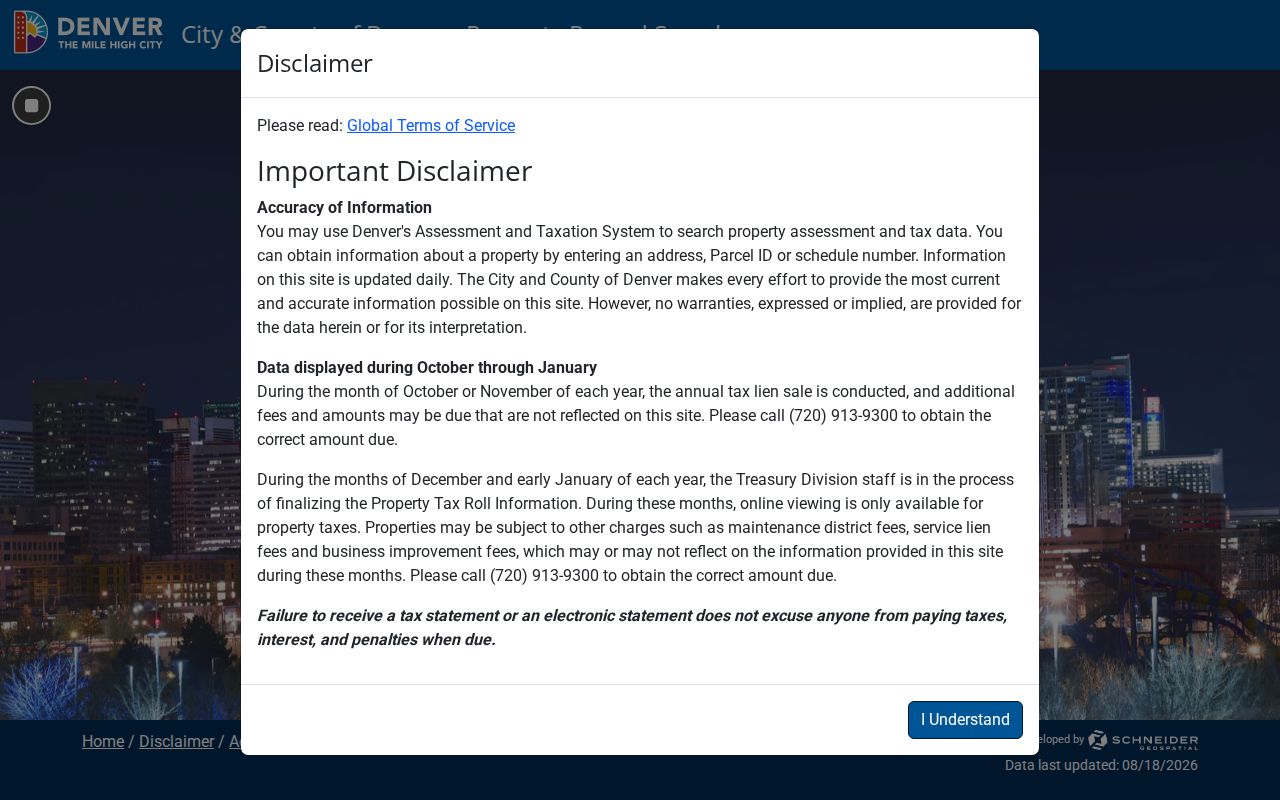
The parcel screen is a starting key. It narrows the record trail without turning an assessment field into a claim about a current household.
Denver Address Records Have Four Fields
Denver address research often fails because one string is asked to fill four roles. Record these fields separately before comparing sources. The distinction is especially useful when a house number changed, a street was renamed, or a parcel owner receives notices somewhere else.
- Situs address
- The physical location of the parcel in the assessor record.
- Mailing address
- The destination for an owner's notices, which may not be the parcel.
- Legal description
- The lot, block, subdivision, or metes-and-bounds language that can survive a street-string change.
- Postal delivery address
- The USPS routing form of the address, including the ZIP and recognized locality.
DOTI's address policy places assignment with the City Engineer or designated authority under DRMC §49-56 and the 2010 policy. The request route lists Addressing@denvergov.org, 720-865-3002, e-permits, and a $60 charge per address or unit. A street rename changes legal documents, maps, and emergency-address references, so the older street name belongs in the search log.
USPS naming adds another layer. A Denver result in the USPS City and State lookup is a postal recognition, not a municipal-boundary ruling. When a locality, ZIP, parcel, and neighborhood disagree, cite the layer that supplied each label. This is the quiet reason a Denver residents directory needs source-specific fields instead of a single “address” column.
Current Denver Resident Directory Sources
Current Denver resident directory work is a comparison of record types, not a hunt for one master roster. The property roll is parcel-first. The voter lookup is person-first and requires four exact fields. PublicSearch is instrument-first, with parties tied to recorded documents. A court docket is event-first. State license, business, custody, and unclaimed-property systems can add a clue, but each has a narrow purpose and a different public boundary.
| Source | Who It Lists | Keeper | Access |
|---|---|---|---|
| Spatialest parcel | Owners tied to a parcel | Denver Assessor | Current online search |
| Colorado voter lookup | Registration match/status | Secretary of State | Name, ZIP, birthday |
| PublicSearch index | Parties to deeds and liens | Clerk and Recorder | Guest index; image limits |
| Court docket | Case parties and events | Colorado Judicial / Denver County Court | Docket or case-number route |
| Business or license filing | Entity or credential clue | Colorado Secretary of State / Department of Regulatory Agencies | Affiliation, not residence proof |
| Unclaimed property | Possible owner-name match | Colorado Treasury | Claim and identity proof |
Official sources and commercial compilations should not be read as interchangeable. The first has a named custodian, a defined record type, and a route for correction. The second may combine public filings with older addresses or marketing data, so name collisions and stale entries are harder to resolve.
| Route | Strength | Limit |
|---|---|---|
| Official custodian | Source, date, field, and correction path are identifiable. | Each portal covers only its own record set. |
| Commercial compilation | May gather several public clues in one result. | Source dates, errors, and correction routes can be unclear. |
Use the assessor when an address is known, Elections when a lawful identity check has the required fields, and the recorder when a transfer or lien matters. The Denver resident lookup page follows the one-person sequence in more detail. A business filing can show a registered agent or principal address, while a DORA result can show license status and profession. Neither proves that a person currently lives at the filed address.
For state custody, the Colorado DOC locator uses DOC number, name, gender, and CAPTCHA. The CBI registry covers only defined public categories and is not a complete criminal-history index. Great Colorado Payback is a free official claim route, but an unclaimed-property match still requires proof. These limits make a dated source log as important as the name itself.
The Colorado Secretary of State business search illustrates an organization record that can support, but cannot replace, a resident lookup.
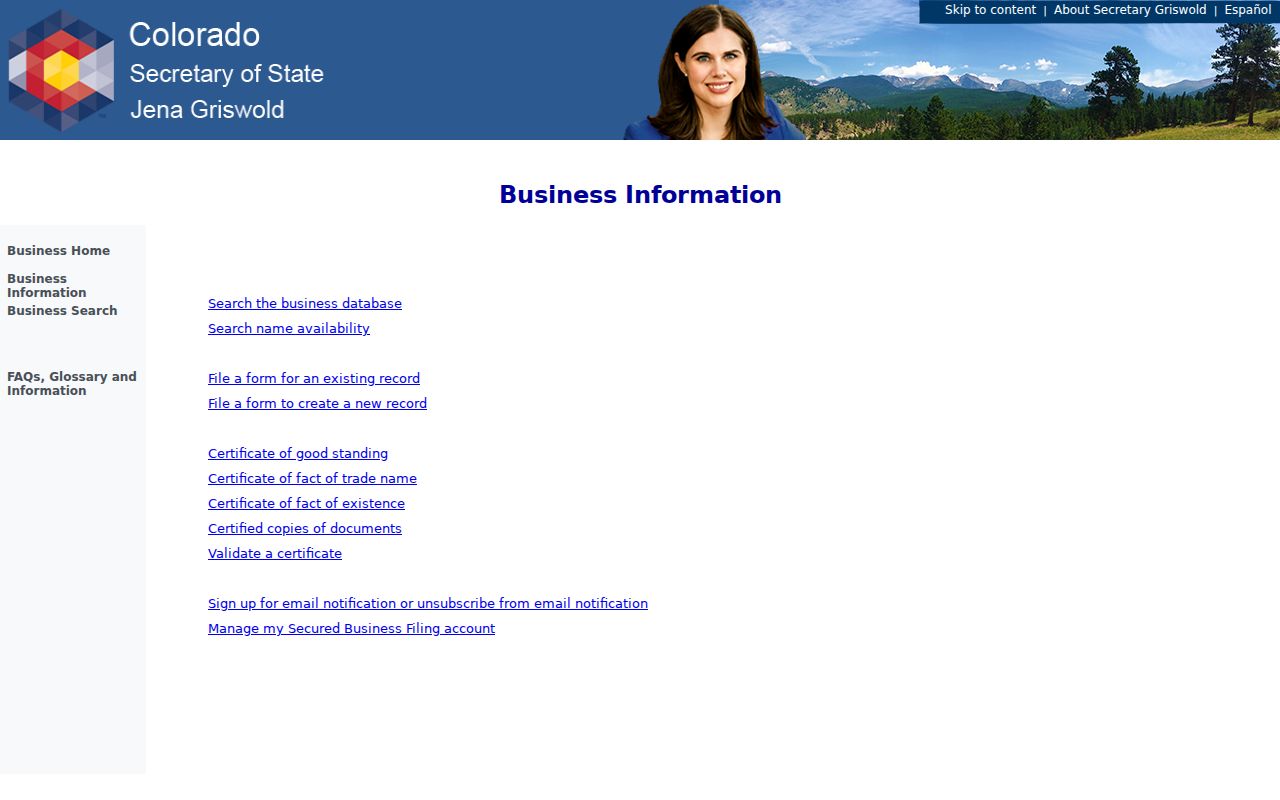
Read an entity address as a business contact field unless a second source gives it residential context.
Denver Voter Lookup Uses Four Fields
The Colorado Secretary of State lookup is narrow by design. It asks for first name, last name, ZIP, and birthday. A recent mover can try a prior ZIP, but a no-match still has several explanations. The record may be confidential, the voter may be under 18, the name may be entered differently, or list maintenance may have changed status. The result is a registration-match workflow, not a downloadable street roster.
| Field | Why it matters |
|---|---|
| First name | Matches the registration name. |
| Last name | Matches the registered surname. |
| ZIP | Narrows the match; a recent mover may need a former ZIP. |
| Birthday | Separates people with similar names. |
Colorado's voter-data materials distinguish public categories such as name, residential and mailing address, year of birth, party affiliation, vote history, and active or inactive status from protected values such as full birth date, identification data, and confidential records. C.R.S. §1-2-227 treats registration records as public subject to its exceptions, while election confidentiality rules protect qualifying addresses. A blank lookup should be recorded as an unresolved result, not as proof that no registration exists.
The Colorado voter lookup capture shows the required name, ZIP, and birthday path used for a lawful, person-specific check.
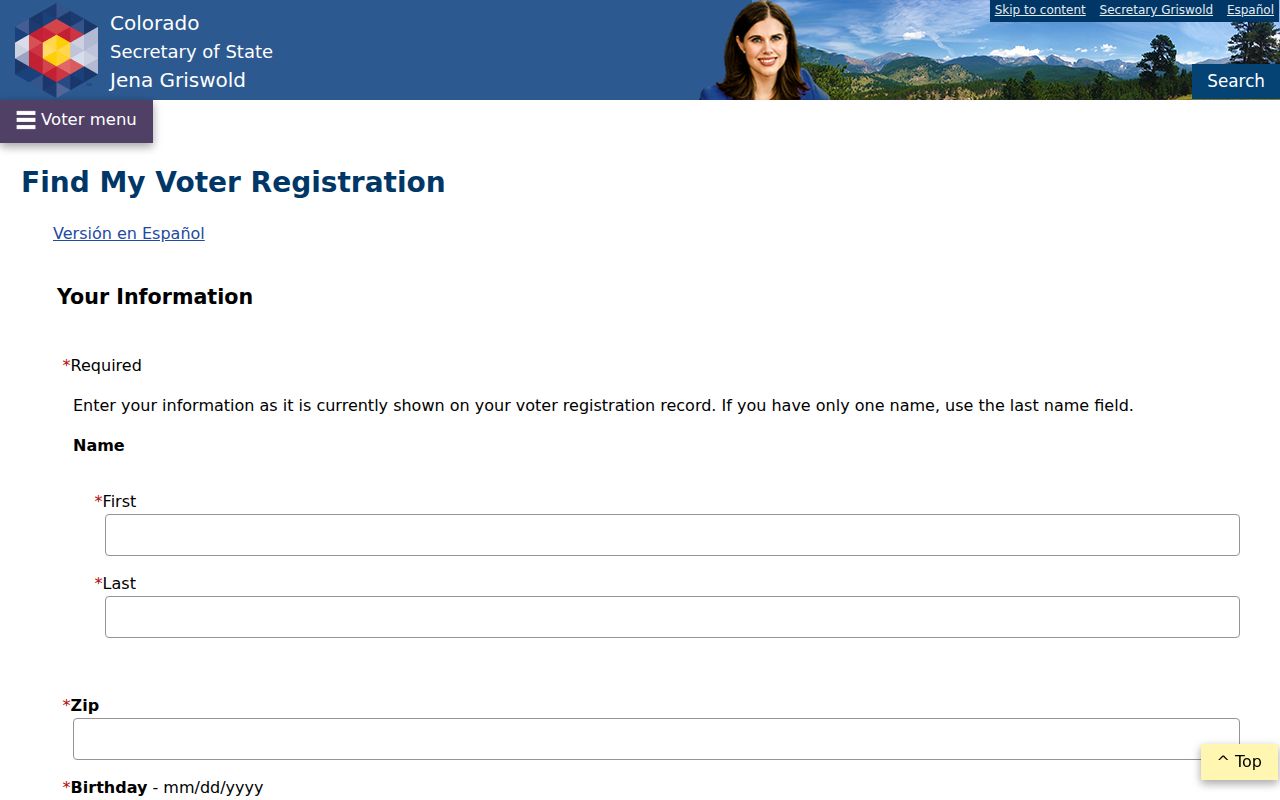
Keep the returned status and the query date. Do not turn that narrow confirmation into a bulk list of Denver residents.
Denver Resident Court Records Need Context
A court name search can supply a useful dated clue, but a docket is not the whole case file. Colorado Judicial's statewide docket filters by judicial district, county, courthouse, court type, division, date, case number, party, or attorney. It requires at least one filter beyond a date. Denver County Court's public portal instead emphasizes case number or arrest booking number, along with limited future court-date forms. Official case information generally needs a valid case number.
| Route | Search basis | What it can show | Next step |
|---|---|---|---|
| Colorado Judicial docket | Location, date, case, party, attorney | Calendar and docket events | Request the file from the court |
| Denver County Court | Case number or AB# | Limited case/date information | Use the clerk for official records |
| District of Colorado PACER | Federal party or attorney | Federal case access | Account and current fee rules apply |
A public docket may show case number, court and division, party names, attorney information, event or hearing dates, and disposition or status where the portal exposes it. Complete files, exhibits, transcripts, certified copies, archived cases, and documents behind the docket require the clerk or a formal request. Colorado Judicial's request form lists requester, case, document, location, and delivery fields, with generally 3 to 5 business days for processing. Sealed, juvenile, adoption, protected, or expunged material may be absent or redacted.
The statewide docket capture shows the filter model, while the Denver County Court capture shows the case-number and booking bridge.
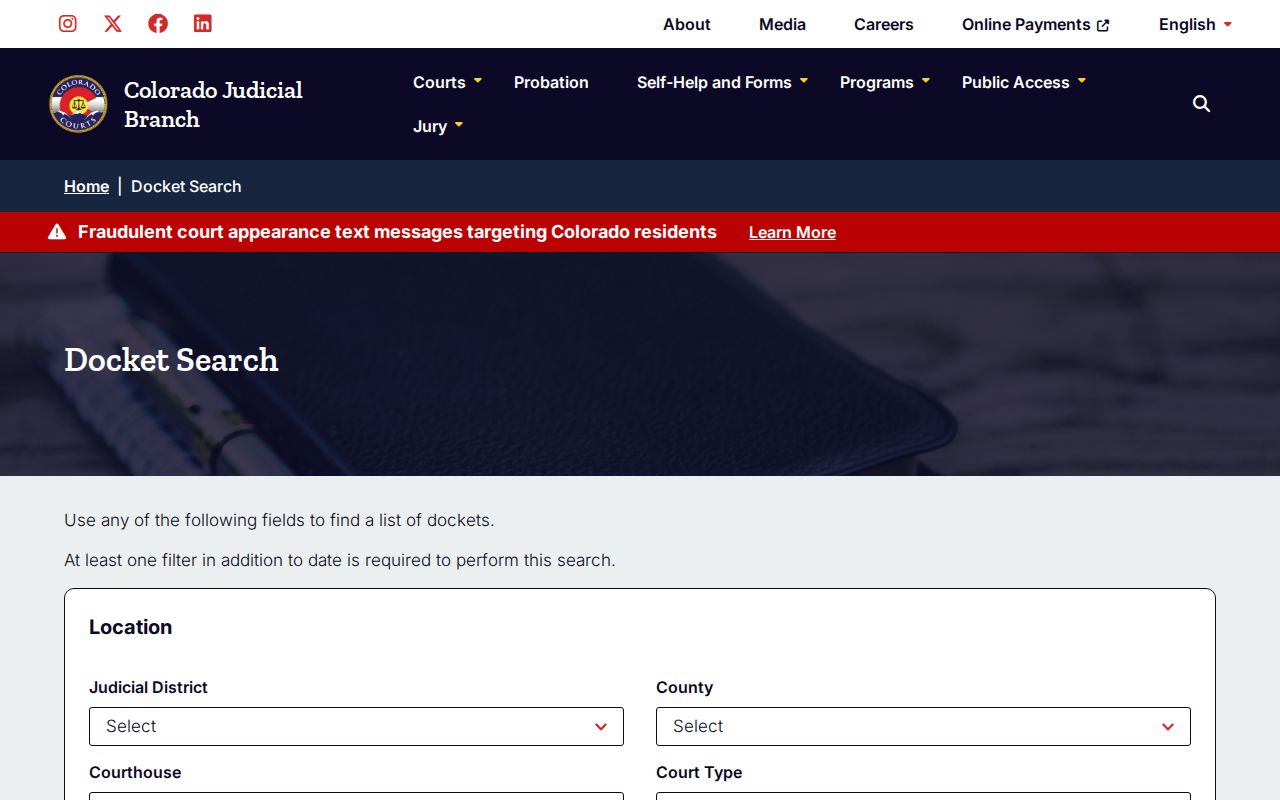
Use a court result as one dated record in a verification packet, never as a stand-alone identity conclusion.
The Denver County Court quick-search capture shows the case-number and arrest-booking route used for a narrower check.
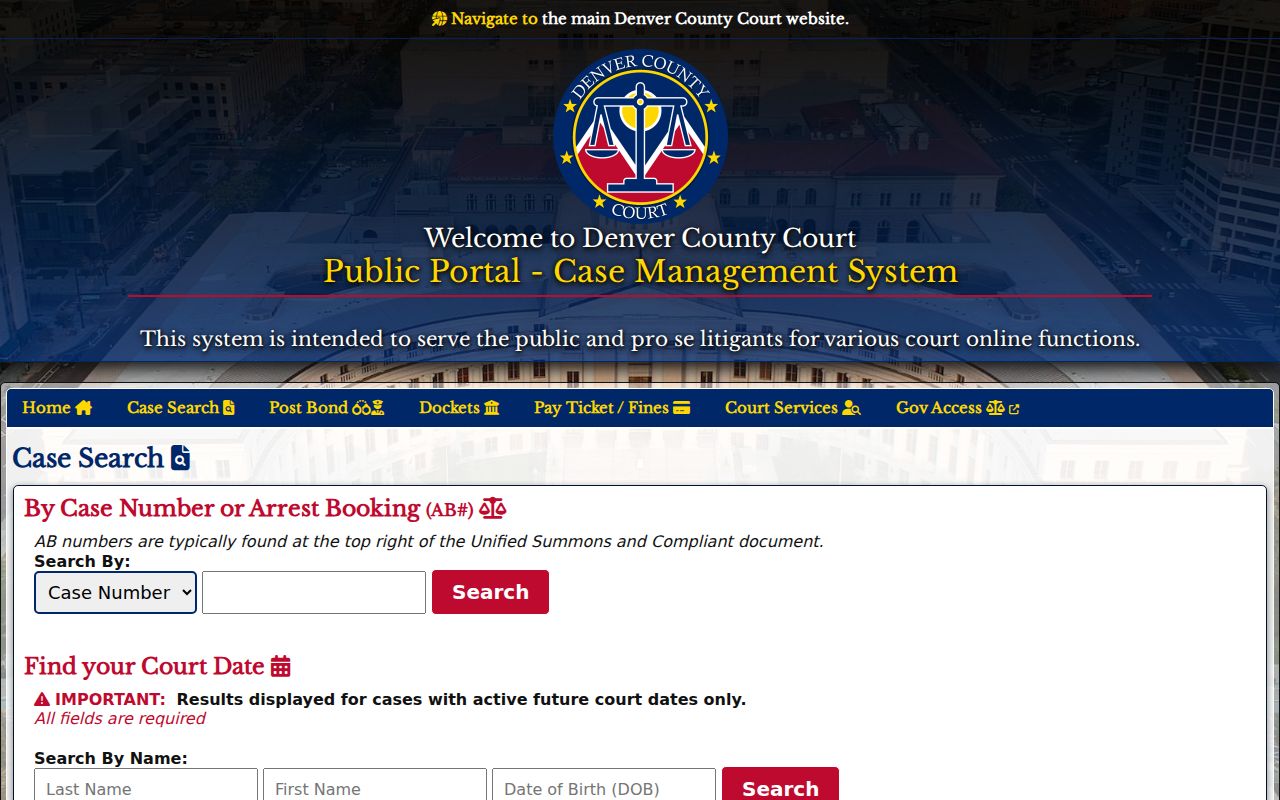
The Denver County Court portal's limited search explains why a clerk request may be needed even when a name is known.
Denver's 160-Year Record Trail
Denver's recording history has a long digital horizon and a stubborn paper edge. The 2021 records-management audit describes a CountyFusion database with more than 11 million documents from 1859 to the present. Newly imaged records are uploaded overnight for next-day availability, yet non-digitized paper remains in city and offsite storage. The phrase “1859 to present” therefore describes the database span, not a promise that every deed image is online.
The Clerk and Recorder's guest search begins with a party name, department, and recorded-date range. PublicSearch also offers index-only or full-text OCR modes, plus advanced party, grantor, grantee, reception, document type, book/page, and document-text fields. A reception number is the stable handoff when the index points to a missing image. DPL's guide highlights an older 1859 to 1986 grantor/grantee route, and DPL has selected digitized books from 1859 through 1884.
The Denver Clerk and Recorder routing capture shows the official handoff among local record systems.
The current routing page is the right place to verify office instructions before sending a request.
The PublicSearch advanced-index capture shows the party and instrument fields that turn a parcel clue into a deed trail.
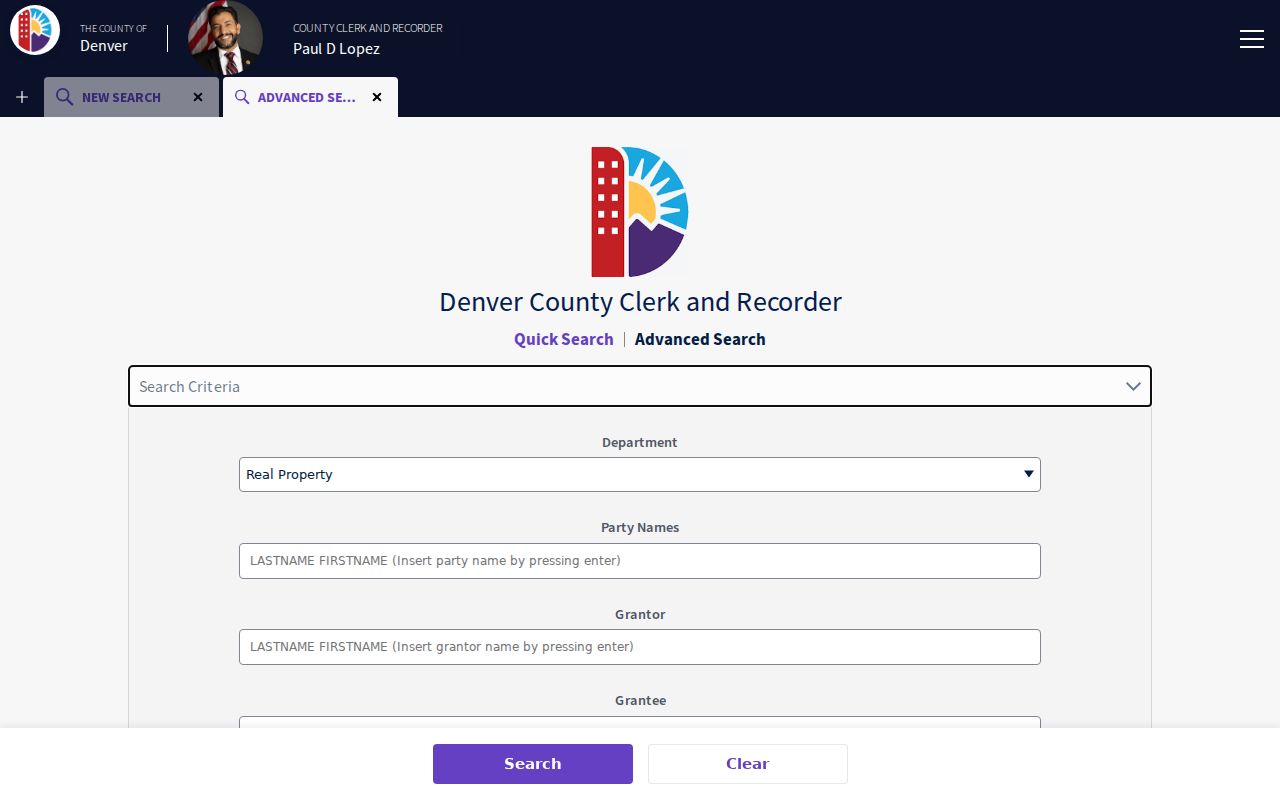
Index access and image access are separate steps. Keep the reception number, search terms, and source date together.
Historical Denver Resident Directories
Denver Public Library's historical shelf is broader than one alphabetical book. SCA holds city directories on microfilm from 1866 to 1981, digitized city directories from 1873 to 1923, and Ancestry Library Edition coverage that includes 1866 and 1871 to 1979. Householder, street, and criss-cross directories run from 1924 to 2018 in the holdings, with 1924 to 1937 digitized. Polk examples include 1899, 1913, and 1960 to 1996. The Denver city directory collections page explains how to read those sets without confusing a person-first entry with an address-first one.
A directory can show a name, address, occupation, household notation, a move, or a printed cross-reference. It can also show the civic texture of a year in its front City Record pages: officials, wards, schools, churches, public buildings, street changes, and ads. The record is historical evidence, not current occupancy proof. Pair the year with a deed, permit, newspaper, obituary, or later directory.
Denver's directory story has a useful numeric edge: the collection reaches from nineteenth-century city runs through late twentieth-century householder material. That long span helps bridge census years and gives an old address more than one chance to appear under a changed spelling or street number.
Denver Vital Records Are Confidential
Colorado vital records are not a public online name index in the inspected official sources. C.R.S. §25-2-117 treats vital-statistics records as confidential and allows a certified copy for an applicant with a direct and tangible interest. Identification and relationship or legal-interest proof may be required. Birth, death, marriage, civil union, adoption, and dissolution routes use different custodians, and a court case file is not the same product as a state verification.
For Denver research, CDPHE and local offices handle birth and death routes, the Clerk and Recorder handles local marriage copies, and the district court holds divorce or separation files. The state ordering route states that online processing is normally 30 business days from receipt and that the 2026 fee notice changed product costs. The exact current product fee should be checked in the live application. DPL newspapers, obituaries, directories, cemetery material, and State Archives finding aids are often the practical first pass for family history.
The Colorado vital-records office capture shows the official route for an eligible request.
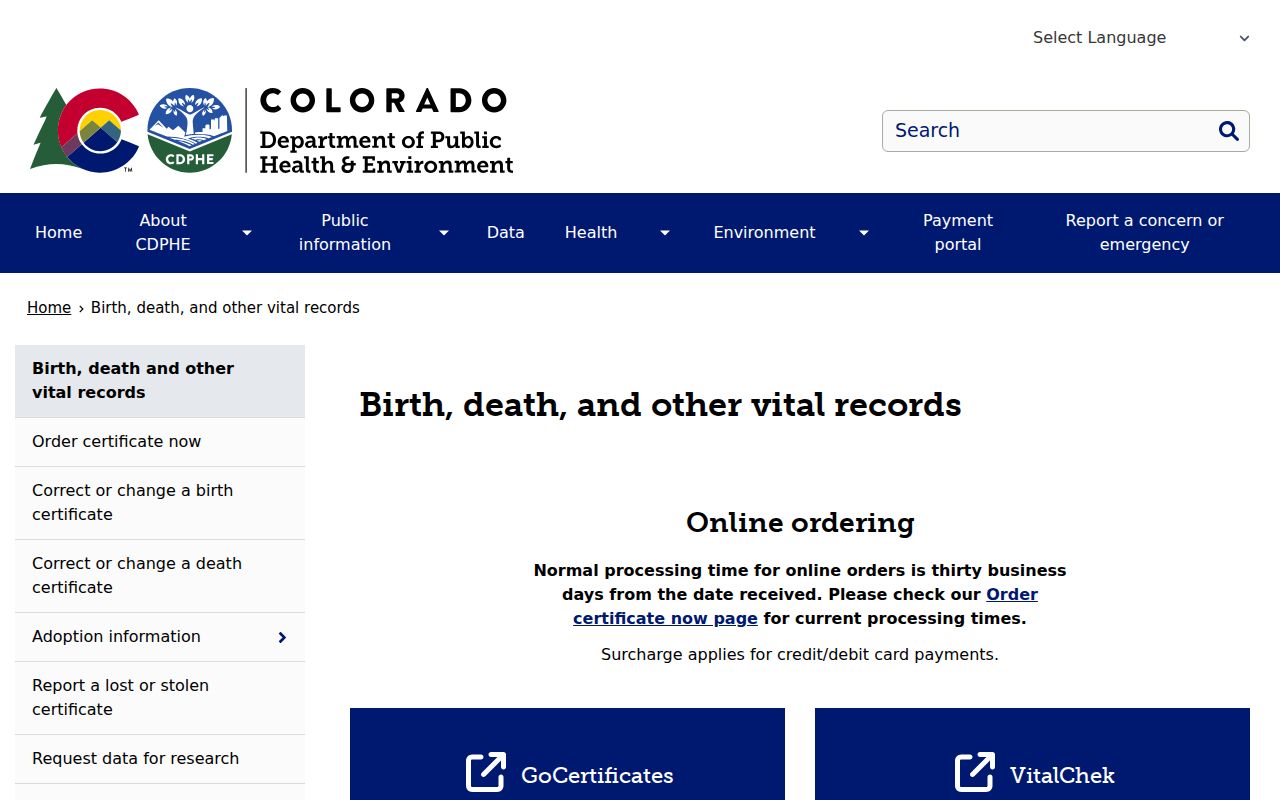
The ordering path is governed by eligibility, not by a general public name search.
The certificate-order capture shows the separate application path for a record that can be released.
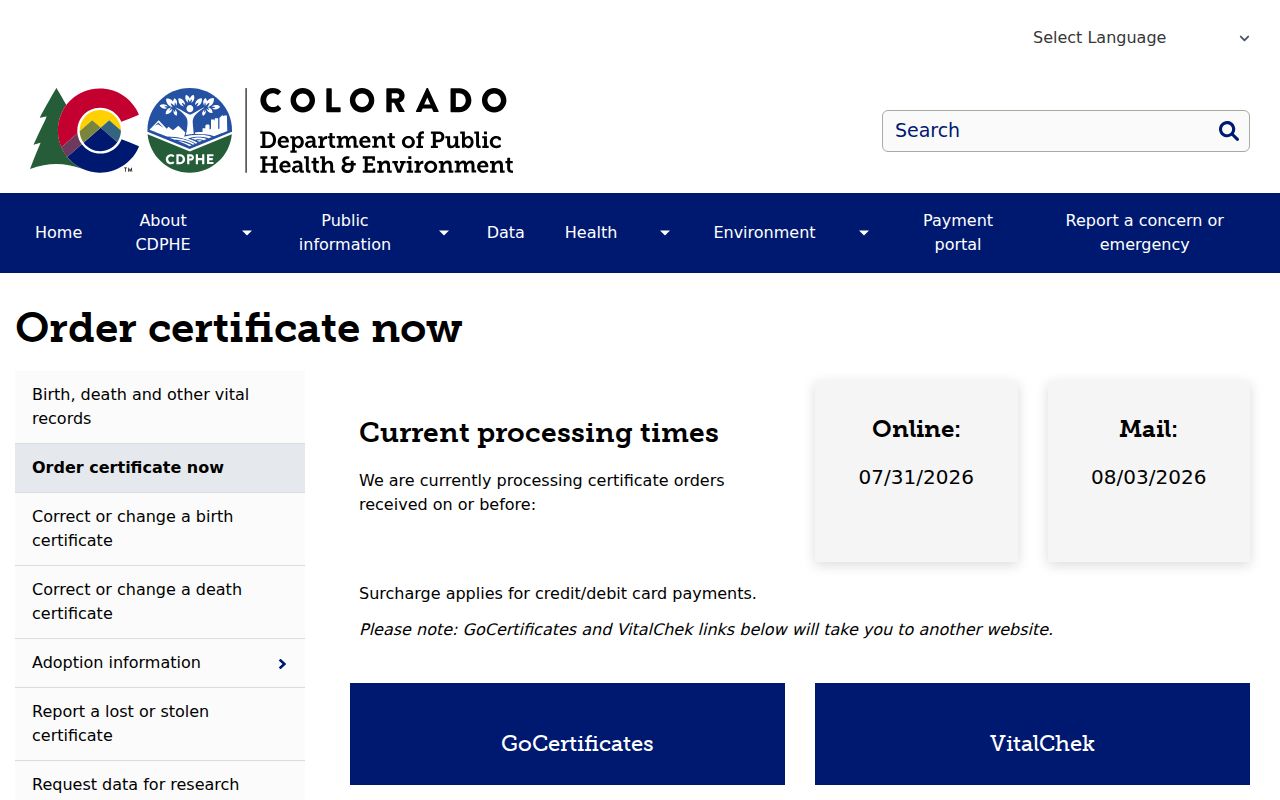
When the certificate is restricted, a dated obituary or directory citation can still supply a family clue without pretending to be the certificate.
Protected Denver Records and Addresses
Public records have boundaries. Colorado's Address Confidentiality Program gives qualifying survivors a legal substitute address and mail forwarding. Election rules can shield the participant's actual address, county, precinct, and split. Colorado's 2025 first-responder confidentiality changes add another current protection route. A voter lookup that returns no match may be working as designed.
The same caution applies to other sources. Vital certificates require direct and tangible interest. Courts can withhold sealed, juvenile, adoption, or expunged material. Motor-vehicle information is controlled by federal privacy rules. Recorded documents can contain names and addresses, but unnecessary personal details should not be copied into a research note or shared page.
Lawful personal use. Use Denver record sources for family history, civic research, property history, and other lawful purposes. Do not use a name, address, or record result to stalk, harass, threaten, or harm anyone.
For private data held by a covered controller, the Colorado Privacy Act, C.R.S. §§6-1-1301 through 6-1-1313, provides access, correction, deletion, and opt-out rights in the situations the law covers. Global Privacy Control is the recognized universal opt-out mechanism described by the Colorado Attorney General. Those rights do not erase a lawful county deed, court file, or historical library volume.
Denver Records Letters Need Checking
Denver record research also has a consumer-safety angle. A letter may offer a deed copy or monitoring service at a high price, while the official Clerk and Recorder routes a researcher to its own index, copy instructions, and FraudSleuth alert. Colorado's Great Colorado Payback says claims are free. A court payment demand should be checked against the published courthouse number, not the number in the letter.
| Message or offer | Verify with | Safe first move |
|---|---|---|
| Deed or property notice | Denver Clerk and Recorder | Use the reception number and official records route. |
| Unclaimed-property fee request | Colorado Treasury | Start at Great Colorado Payback; a basic claim is free. |
| Court payment demand | Denver County Court or the right clerk | Call a number published by the court. |
| Identity or phishing message | Colorado Attorney General guidance | Type the official URL and keep the original message. |
The research record should include the source URL, date, record type, and citation, while omitting an exact birth date, ID number, personal phone, or protected address unless the custodian requires it for a formal request. A trustworthy Denver residents directory workflow makes uncertainty visible and sends the final question back to the office that holds the record.
The Colorado DOC search capture is a reminder that even an official lookup has a defined scope and should not be read as a complete history.
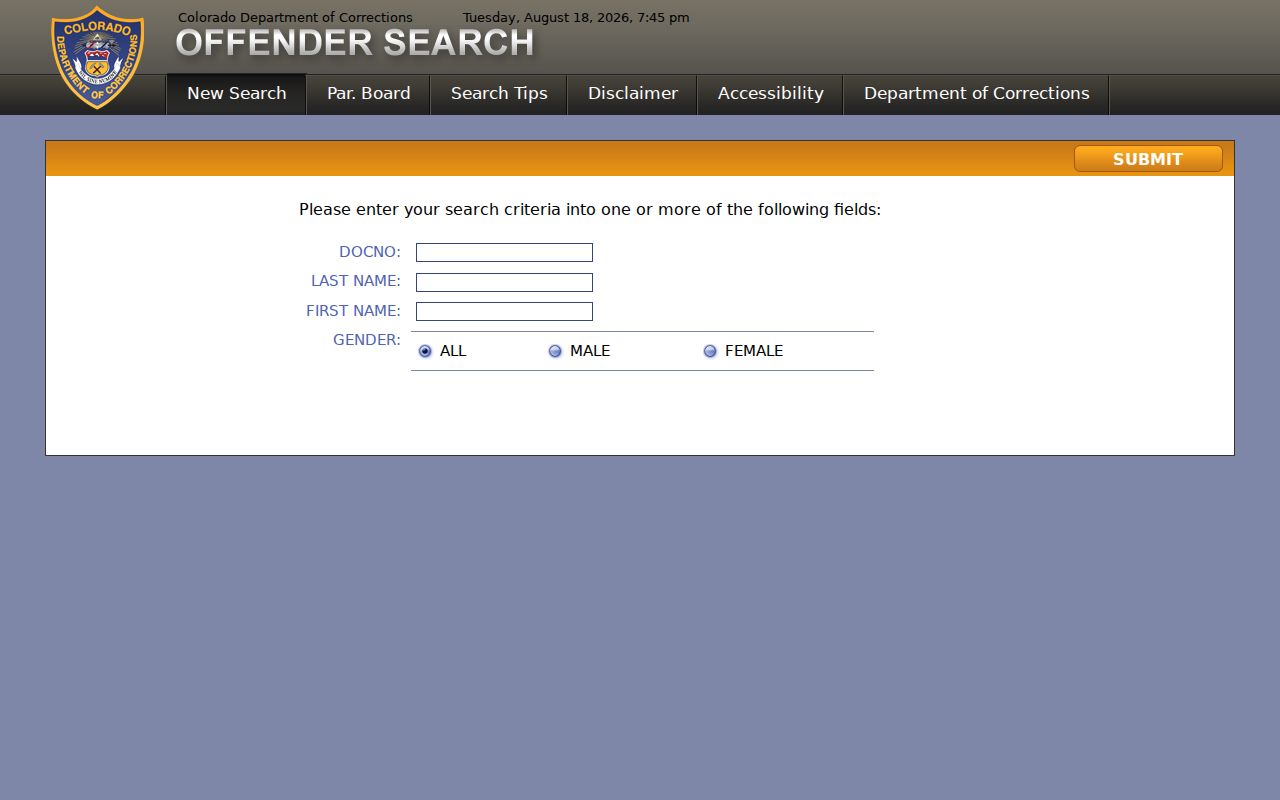
A scoped result is more useful than a broad claim. Save what the portal actually says.